
This article follows on from a previous article by Graeme McConnell. LINK HERE
‘Good Change’ is the literal translation of ‘Kai – Zen’, a Japanese term for continuous and incremental improvements.
Have you been through a busy period and felt like you started out well-organised? You knew exactly what needed to be done, could visualise how it would unfold, communicated your expectations to all and sundry — and then pressed the “GO” button.
Over a short period you watched the best laid plans deteriorate first into ‘orderly chaos’. With increasing frequency, on-going unpredictable events added to stress and resulted in falling productivity. This was followed by a further disintegration into flat-out chaos. Result – Frustration, dissatisfaction and maybe even a measure of irritation.
If you have experienced this – you are not alone.
So why does this happen – and what can you do about it?
The first step is recognising why this occurs, and here is the principle from which to learn.
Why Order Breaks Down
The first step is recognising the underlying source, or ‘Root Cause’ as is the modern buzz term.
When an Owner/Experienced operator works alone, they often complete multiple tasks over many hours, and the system runs smoothly because:
- They rely on their own experience, memory, habits, and personal workflow.
- They are capable of making rapid decisions without consultation.
- The tools, machines, and resources are exactly where they left them — and in the condition they expect to find them.
But introduce a second operator, and the system changes instantly.
Operator #2 needs the same tools, machinery, and resources — and uses and moves them. When Operator #1 returns, nothing is where they left it. The situation compounds when Operator #2 returns later, to find Operator #1 has changed the environment again.
Each operator becomes a “disruptor” to the other. Efficiency drops. Frustration rises. Blame begins to circulate. What’s happening is both parties are making decisions – creating uncertainty.
This isn’t a people problem — it’s a system failure.
It gets worse with multiple operations and an increased number of participants. Blame is often levelled at the wrong person, and that initial calm determination within a larger workforce gives way to frustration and a loss of tolerance. As pressure mounts, the original ‘plans and order’ are all but lost, and chaos emerges from the darkness of frustration.
At that point, everything feels like hard work.
You would think the solution would be easy!
“Put it back where you got it from, leave it ready for the next operator, and do as I do”.
If only it was that simple.
- So why does it happen?
- What gets lost?
- Where did all the order go?
- Why is no-one doing what is expected of them?
In a nutshell, complex tasks cannot be duplicated reliably without structure. It’s more complicated than “do as I do” because on-the-spot decisions are unpredictable and multitudes of small but significant decisions need to be made.
Even when tasks have been listed in detail, without the establishment of systems, communications fall short and above all, a routine based on common sense has not been established.
Good Change
This is where the principles of ‘Good Change’ (Kaizen) can be employed. There are 2 simple principles to discuss. The five (5) S’s and PDCA. These are inter-dependent and complementary.
1. The 5 S’s
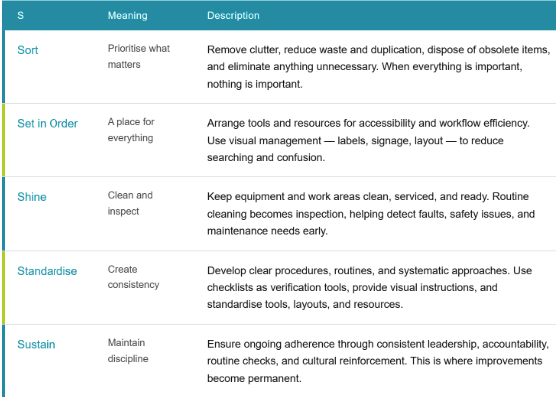
Why do the 5 S’s matter?
Although they look like “good housekeeping”, they do far more. They create operational visibility — the ability to see problems early, maintain order, and reduce friction.
Small, disciplined changes improve:
- Productivity
- Safety
- Workmanship and quality
- Training effectiveness
- Asset utilisation
- Staff morale
2. PDCA – Plan, Do, Check, Act
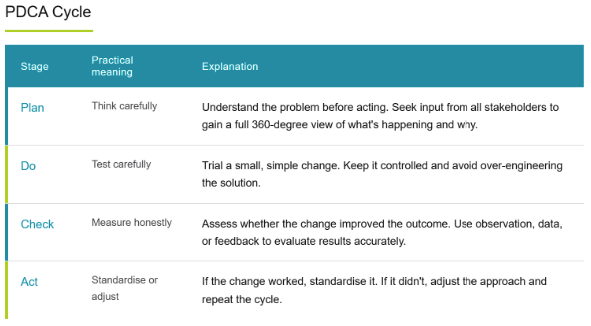
Why does PDCA matter?
“PDCA introduces structured diagnosis, controlled experimentation, evidence-based adjustment.”
Seek input from all the stakeholders at the Plan stage. This implements what is commonly referred to as 360-degree input. Improvements can come from all levels of your business.
The application of PDCA turns reactive chaos into structured control and learning, with complete buy-in by all the stakeholders.
Combined Results Lead to an Operating Rhythm.
Rhythm (def) – a strong, regular, repeated pattern of movement, sound, or time.
Rhythm sounds like another buzz word – but in fact its definition is applicable to repetitive operations. Business rhythm is the structured repetition of planning, execution, review, communication, and adjustment.
What can you expect from Good Change (Kaizen) and Rhythm?
Farming business operations need to be orderly, calm, predictable and above all, flexible to manage change in conditions and environments.
The results are operational tasks with outcomes that offer 1. less firefighting, 2. clear priorities, 3. reduced mental load, 4. faster training, and 5. more predictable work.
Next time you recognise operations are becoming chaotic, stop and look at the causes.
- What are simple changes that can be adopted to reduce confusion?
- How can the change be implemented?
- Who should be a part of the communication chain for continuous improvement?
Good Change (Kaizen) is not about speed. It is about consistency, visibility, discipline and continuous learning. It helps create a business rhythm. The Business Rhythm is a mechanism that makes these valuable behaviours stick.
Chaotic darkness will subside back into order.