The current seasonal outlook has many weighing the “should I or shouldn’t I” of their cropping programs. It is a moving feast of scenario planning; on one hand, we have the immediate prospect of a cyclone on the doorstep, potentially providing ideal seeding moisture, while on the other, we are navigating the high cost and availability of inputs (including for most sub-optimal Nitrogen available).
To simplify the decision-making process, it is helpful to categorise your hectares into three strategic groups:
- Priority 1: The “Definites” – High-potential areas such as lupin stubbles or recently deep-ripped country.
- Priority 2: The “Probables” – Your reliable, high-quality “good dirt” that consistently performs.
- Priority 3: The “Maybes” – The final portion of the program, often consisting of weaker country or paddocks with high weed pressure or needs more N.
While the exact percentage of each group varies by enterprise, it is important to remember that “doing nothing” is often an equally expensive exercise.
The Variable Cost Threshold
From a purely financial perspective, a paddock remains a viable candidate for seeding if the projected yield comfortably covers its variable costs. These include:
- Seed and Treatments
- Fertiliser
- Chemicals
- Cost of operations including fuel, wages, depreciation, repairs.
Once you know what yield you need, if estimated income exceeds these variable costs, you are officially in a better position than if you had left the land fallow. Every dollar earned beyond that threshold begins to “clip the ticket” of your fixed costs.
Understanding the Margin
The hierarchy of farm profitability follows a clear progression:
- Variable Costs: The baseline requirement to put the crop in.
- Fixed Costs: Overheads that exist regardless of production.
- Surplus: Once fixed costs are covered, the remaining income services finance, living expenses, and equipment depreciation.
In many instances, just to meet variable costs is still a surprisingly low yield and you are in the game for if the yield or price prospects improve. As shown in the sensitivity analysis below, the economics can improve remarkably for each 150kg or $10t.
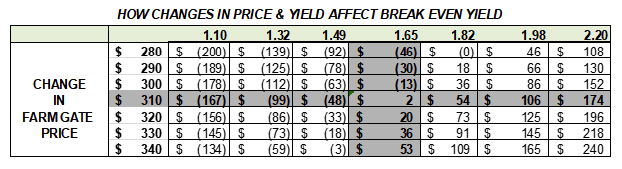
In some instances, even if a budget reflects a net loss, proceeding can still be the superior strategic move. If the crop contributes toward fixed costs and beyond, you are mitigating a larger loss that would have occurred by doing nothing. More importantly, it keeps you “in the game,” ensuring you are positioned to capitalise should grain prices move favourably before harvest.